Website template licences explained in plain language
What a website template licence lets you do: end products, seats, client work, resale, and the fonts, images and video inside, with a worked example.
A website template licence tells you how many sites you may build with the template, how many people may use it, whether you can build for clients or sell the result, and what you may never do with the template files themselves. Almost every licence is built around the "end product", the finished website, and almost every licence forbids passing the template on so someone else can build with it. Read those two parts first, then check the fonts, images and video inside.
Note: This is a plain-language guide, not legal advice. The licence text you agree to is what counts. If a project carries real risk, have a lawyer read it.
The end product is the unit that matters
Most template licences count end products, not downloads or copies. An end product is the finished thing you make with the template, customised with your content.
Marketplaces define it in similar ways. ThemeForest's licence FAQ gives the example that when the item is a website theme, the end product is the final website customised with your content. Webflow's template licensing page says paid templates allow one end product for yourself or one client.
Our definition is: one website for one business, product or person, on one domain and its subdomains. A redesign of the same site stays the same end product. So a startup's marketing site at its main domain, with a blog and docs on subdomains, is one end product. A second product with its own brand and domain is a second end product.
The practical questions to ask of any licence:
- How many end products does this purchase cover?
- Does a staging site or a redesign count as a new one? (In ours, a redesign of the same site does not.)
- What happens if the business rebrands or moves domain? When in doubt, ask the seller and keep their answer in writing.
Personal, team and unlimited
The second axis is people. A licence may cover one person, a fixed number of seats, or a whole organisation. This matters more than buyers expect: if a designer buys a template on a personal licence and then three colleagues and a contractor work on the site, check the licence covers them all.
Licences also differ on how many end products they cover. Some allow one site per purchase, so every new site is a new purchase; Webflow's single-use licence works that way. Some cover unlimited end products for the licence holder. Some subscriptions license items per project for as long as you subscribe: Envato Elements explains that items in end products completed during a subscription stay licensed, but you cannot start new end products with them after it ends.
Client work and selling the finished site
If you are a freelancer or agency, two separate permissions matter:
- May you build a site for a client at all? Most licences say yes, for one client per end product.
- May the end product be sold, or must it be free to its users? ThemeForest is the clearest example of this split: the Regular License covers an end product distributed for free, and the Extended License covers one that may be sold.
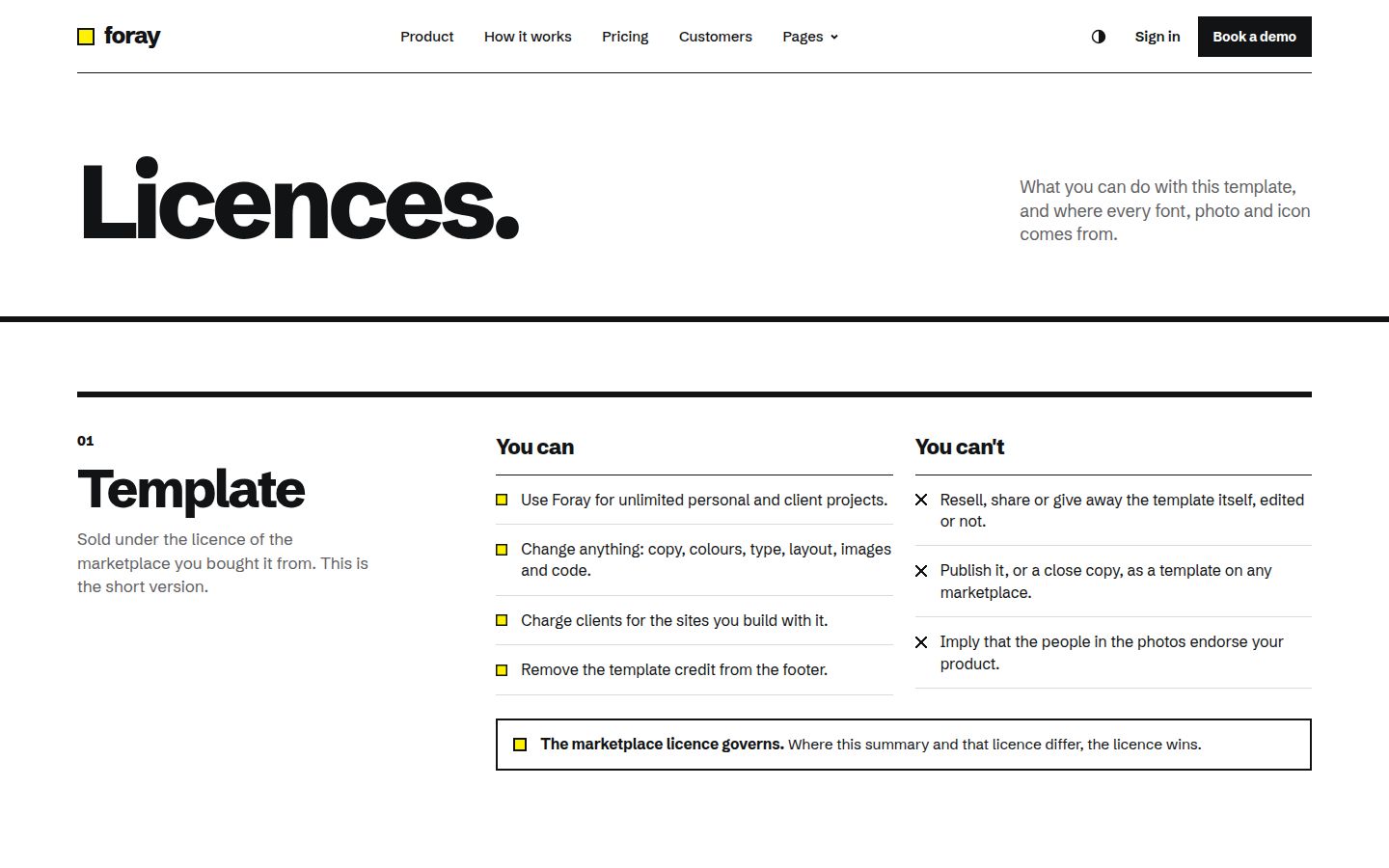
Do not confuse selling the finished site with reselling the template. Charging a client for a website you built with a template is normal and widely allowed. Selling or sharing the template files, or a lightly changed copy of them, so that someone else can build sites, is what almost every licence forbids.
What you may never do
The restrictions look similar across most sellers. Expect a licence to forbid some version of:
- Reselling, sharing or redistributing the template files, whole or in part.
- Using the template inside another template, theme or UI kit you sell.
- Offering the template inside a website builder, app or service where other people build sites with it.
Framer's community terms, for example, say a paid marketplace template is licensed for one end product and may not be resold, redistributed or used to create competing templates.
Fonts, images and video inside templates
A template licence covers the template. The fonts, photos, illustrations, icons and video inside it may come with their own licences, and those can be stricter than the template's.
Fonts: many templates use fonts under the SIL Open Font License. Google Fonts' FAQ says its fonts can be used commercially, and the OFL FAQ explains that OFL fonts may be used, modified and bundled freely as long as they are not sold by themselves. Commercial fonts are different: each foundry sets its own terms, and a template that uses one may expect you to buy your own licence for it. Check before you launch.
Images and video: demo photos in some templates are placeholders you are expected to replace, or are licensed for the demo only. Check whether each image is cleared for your use or needs replacing before launch.
Icons and data: icon sets and map data have licences too, often open ones with an attribution requirement.
What to look for is a page that lists every asset with its source and licence. If a template does not have one, ask the seller before you launch.
A worked example: the Frontier licence
Here is our own licence matrix, because a real example is easier to read than general rules. It is the same table as on our licences page.
| Personal | Team | Full Access | |
|---|---|---|---|
| Use it for your own site | Yes | Yes | Yes |
| Use it for a client's site | Yes | Yes | Yes |
| End products | 1 | Unlimited | Unlimited |
| People who can use it | 1 | Up to 10 | 1 |
| Commercial use | Yes | Yes | Yes |
| Sell the finished site to your client | Yes | Yes | Yes |
| Credit to Frontier required | No | No | No |
| Resell or share the template files | No | No | No |
| Use it in a template, theme or kit you sell | No | No | No |
| Offer it inside a website builder or app | No | No | No |
Reading it as three buyers:
- A founder building their own startup's site buys one template on the Personal licence. That covers one end product, used by one person, commercially, with no credit required.
- A five-person studio building client sites takes the Team licence ($159). Up to ten people can use it, for unlimited end products, and each finished site can be sold to its client.
- A freelancer who wants every template takes Full Access. It covers unlimited end products for one person. The plans, including the early-bird $99, are on the pricing page.
What stays ours in every case is the template itself: its design, code and files. The licence lets you build sites with it; it does not let you pass the template on, in whole or in part, so that someone else can build sites with it.
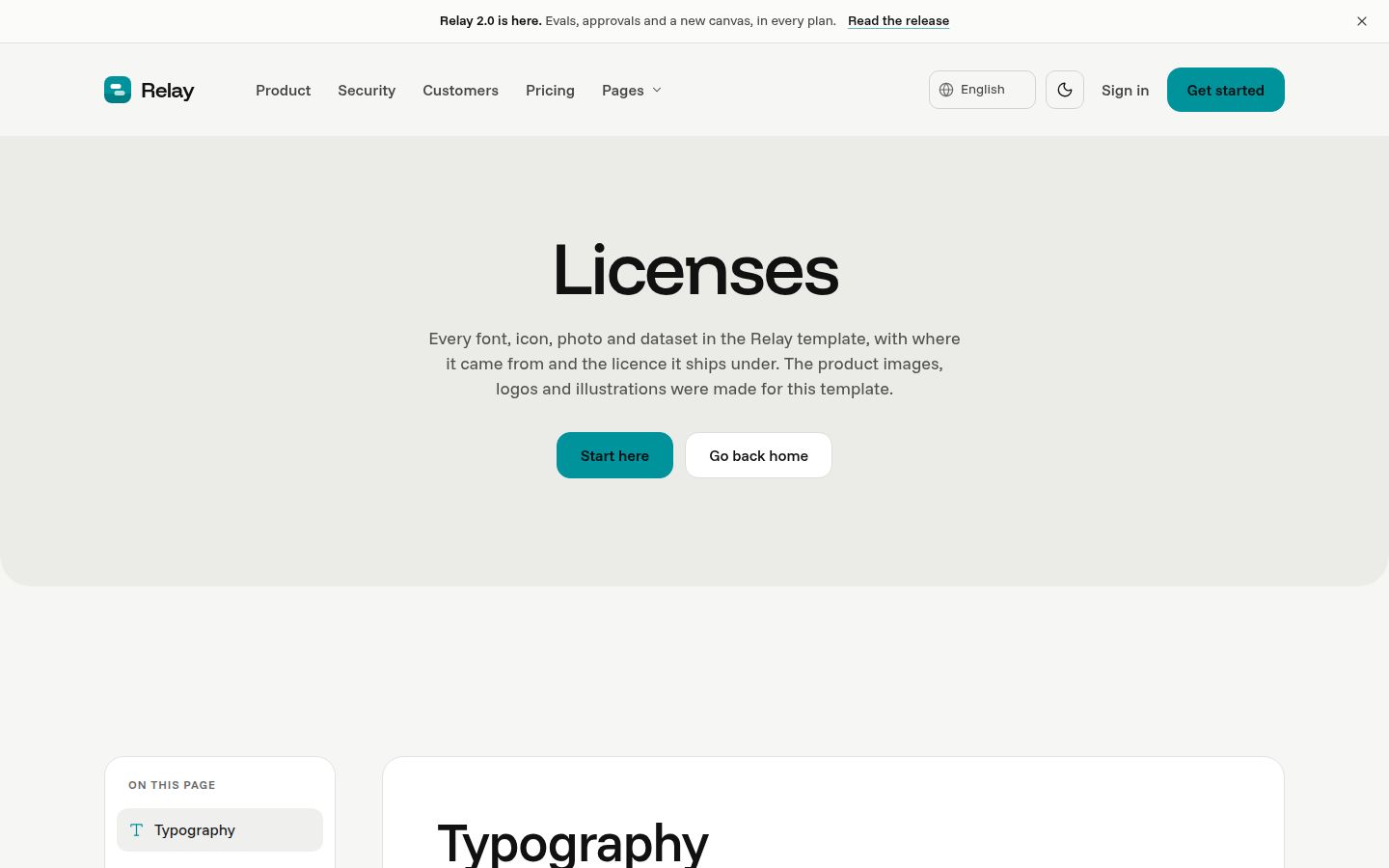
On assets: every image and font in a Frontier template is either our own or free to use commercially, and each template's licences page lists them with their sources. Some examples from the catalogue: Relay uses open-licensed fonts, icons and map data; Halden uses Inter Tight and Newsreader, with film and photos licensed for commercial use; Mordant generates its images, illustrations and app screens in code, so there is no stock photography to license.
One exception: if you bought one of our templates on the Framer or Webflow marketplace, that marketplace's licence applies to that purchase instead of ours.
A checklist before you buy
- How many end products, and how is an end product defined?
- How many people may use it, and does that include contractors?
- Is client work allowed, and may the finished site be sold?
- Is credit to the author required anywhere on the site?
- Are updates included, and for how long?
- Is there a list of fonts, images, icons and video with their licences?
- Which purchases fall under a different licence, such as marketplace sales?
If you are comparing sellers, our post on where to buy a website template compares licence models across marketplaces, builders, free directories and studios. For the pages and files a template should include beyond the licence, see what a complete template includes. Or browse AI website templates with the licence terms above.
Changelog
- 2026-10-05: first published